
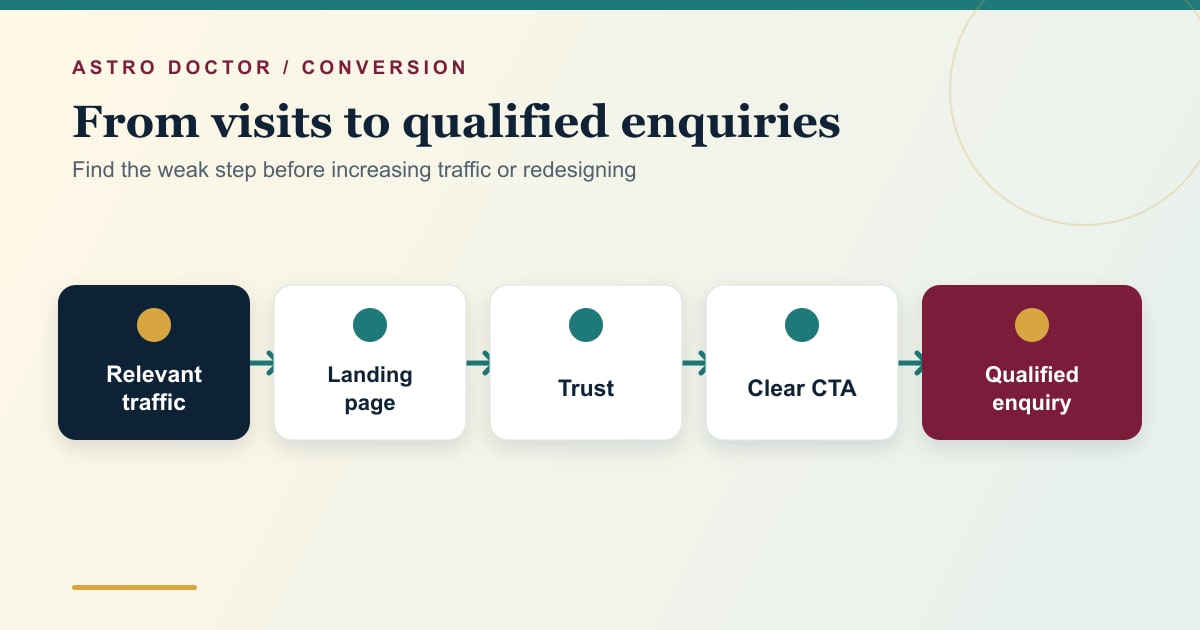
An astrologer can receive visitors from Google, social media, YouTube or paid advertising and still wonder:
Why is nobody contacting us?
The easy response is to generate more traffic.
That can make the problem more expensive.
When visitors arrive but few relevant enquiries follow, the website should be treated as a conversion system.
The first task is diagnosis.
1. Confirm that the traffic is relevant
Before changing the design, inspect where visitors come from.
Traffic may arrive for:
- free horoscope information;
- educational articles;
- job searches;
- astrology courses;
- practitioner-name searches;
- consultation services;
- unrelated keywords.
A site can have excellent traffic and poor consultation intent.
Questions
- Which landing pages receive traffic?
- Which queries generate impressions/clicks?
- Which countries/cities visit?
- Which channel sends the traffic?
- Are users looking for the services offered?
Use Search Console and analytics together where possible.
2. Separate brand traffic from service traffic
Someone searching the astrologer's name is already aware of the practitioner.
Someone searching:
online career astrologer consultation
is discovering options.
These visitors need different levels of trust-building.
If most organic traffic is branded, the SEO programme may not yet be attracting new commercial demand.
If traffic is informational, the article must connect logically to a relevant service.
3. Check the landing page
Users do not always enter through the homepage.
Review the actual landing pages receiving traffic.
Ask:
- Is the service clear in the first screen?
- Is the page appropriate for the query?
- Does the visitor know who the practitioner is?
- Is the next action obvious?
- Is the content sufficient?
- Is mobile usability good?
A visitor should not need to open five pages merely to understand whether the service exists.
4. Does the page explain who it is for?
Weak service copy:
We provide expert astrology solutions for all life problems.
This says very little.
Stronger positioning may explain:
- consultation type;
- intended audience;
- typical subject area;
- delivery format;
- professional approach.
Specificity helps suitable visitors recognise fit.
5. Is the website attracting people who want free advice?
Astrology websites frequently receive free-question enquiries.
This can be influenced by content and messaging.
Examples of signals that may attract low-intent users:
- "Ask one free question";
- excessive free predictions;
- unclear paid-consultation process;
- no pricing/booking context;
- ad copy implying instant answers.
If the business sells paid consultations, the website should make that clear politely.
6. Is the practitioner visible?
A trust-sensitive advisory site should not feel anonymous.
Review:
- name;
- real profile;
- photograph;
- About page;
- verifiable background;
- public professional presence;
- consultation process.
A visitor sharing personal concerns needs to know who is receiving the enquiry.
7. Are trust signals specific and genuine?
Useful trust signals may include:
- practitioner identity;
- years of experience where verifiable;
- education/training;
- genuine reviews;
- speaking/media;
- professional photographs;
- clear process;
- privacy;
- consistent external profiles.
Weak trust signals:
- invented awards;
- fake logos;
- generic "100% satisfaction";
- anonymous testimonials.
Trust must reduce uncertainty.
8. Does the page explain the consultation process?
A CTA saying:
Contact Now
may not be enough.
The visitor may want to know:
- What happens after contact?
- Is there a fee?
- How long is the session?
- Is it online?
- What information is needed?
- How soon can it be scheduled?
- Is there follow-up?
A short process section can improve clarity.
9. Review pricing strategy
Pricing can influence enquiry quality.
Three common models:
Public pricing
Good for standardised services.
Starting price
Useful when scope varies.
Price after discussion
Appropriate when the service is genuinely customised.
If every visitor must contact WhatsApp just to discover the most basic price, the team may receive many unqualified enquiries.
There is no universal answer.
The correct level of transparency depends on the service.
10. Is the CTA visible and understandable?
The CTA should explain the action.
Better:
- Book Consultation
- Request Consultation Details
- Ask About Career Consultation
- Send a Structured Enquiry
Less useful:
- Submit
- Click Here
- Learn More
A page can have a primary CTA and a lower-friction secondary action.
Do not place ten equally strong CTAs in every section.
11. Review the WhatsApp experience
WhatsApp can create conversion friction even though it appears easy.
Weak flow
Button → blank chat.
User types:
Hi
The team must ask five questions.
Better flow
Website/form → structured first message.
Example:
Hello, I am [Name] from [City]. I am interested in [Service]. My preferred consultation mode is [Online/In-person]. My requirement is [Brief context].
This improves context.
Use WhatsApp Marketing for Astrologers for the complete framework.
12. Is the form too long?
A 20-field form can reduce completion.
Ask only what is needed at that stage.
Possible first-step fields:
- name;
- email/phone;
- city/country;
- service;
- short message.
Do not collect sensitive astrology data before the user understands why it is required.
13. Is the form too short?
The opposite problem also exists.
A form with:
- name;
- phone;
may generate many contacts but no context.
Balance friction and qualification.
The right form depends on:
- traffic source;
- service complexity;
- lead volume;
- team capacity.
14. Mobile experience matters
Many consultation searches happen on mobile.
Check:
- menu;
- text size;
- button size;
- form fields;
- WhatsApp button;
- page speed;
- image size;
- sticky elements;
- accidental overlays.
A desktop site that looks elegant may be frustrating on a phone.
15. Does the website load quickly enough?
Performance does not need to be perfect for every page.
But avoid preventable problems:
- oversized hero images;
- autoplay video;
- multiple heavy scripts;
- unnecessary animation;
- large unused libraries.
A slow page creates abandonment before the message is understood.
16. Does the service page match the traffic source?
Example:
Google Search
User searches career astrology consultation.
Destination: Homepage listing 20 services.
This is weaker than a relevant career page.
User clicks from an educational reel.
Destination: A long booking form with no context.
A supporting article or service explanation may be better.
Meta Ads
User sees cold audience creative.
Destination: Blank WhatsApp chat.
A landing page may be better.
Match readiness.
17. Review the page's information hierarchy
The page should normally prioritise:
- what the service is;
- who it is for;
- why this professional;
- how it works;
- important practical information;
- FAQs;
- next step.
Do not bury the service explanation beneath decorative content.
18. Is social proof close to the decision?
A testimonial may be more useful near:
- process;
- pricing;
- CTA;
than hidden on a separate page.
Use relevant feedback.
Do not repeat the same testimonial everywhere.
19. Are reviews consistent with external profiles?
A website may look strong while external search shows:
- different phone;
- old address;
- negative unresolved listings;
- abandoned social profile;
- wrong business category.
Prospects cross-check.
That is why reputation management is part of conversion.
20. Are users clicking CTA but not becoming qualified?
This is a different problem.
Track:
- page view;
- CTA click;
- form completion;
- WhatsApp start;
- qualified lead;
- booking.
If many people click but few qualify, the problem may be:
- offer mismatch;
- pricing;
- qualification;
- ad targeting;
- expectation gap.
Do not label every click a conversion.
21. Build lead-status tracking
A simple sheet can include:
- date;
- source;
- landing page;
- service;
- city;
- status;
- qualified?
- booked?
- revenue where appropriate;
- reason lost.
Without this data, website decisions remain subjective.
22. Check response time
A strong enquiry can be lost operationally.
If the team responds after 24–48 hours, the visitor may contact someone else.
Set a realistic response process.
Do not promise 24/7 response if it cannot be delivered.
23. Is the copy too vague?
Generic phrases weaken conversion:
- trusted service;
- best guidance;
- personalised solutions;
- life-changing insights.
Explain what the client actually receives.
Specific professional language builds confidence.
24. Is the copy too sensational?
The opposite can also harm trust.
Avoid:
- guaranteed marriage;
- solve business problem in 7 days;
- 100% accurate prediction;
- fear of planetary disaster;
- fake urgency.
Sensational messaging may increase raw enquiries while reducing quality and reputation.
25. Is the page answering objections?
Common questions:
- Is it online?
- How long?
- What should I prepare?
- Can I reschedule?
- Which language?
- Is follow-up included?
- What is the fee?
- When is the next slot?
Answer the most important ones before contact.
26. Is the user given too many choices?
A page with:
- Call
- Telegram
- Messenger
- Instagram DM
- Book
- Request Call
- Live Chat
can create decision friction.
Choose a primary conversion path.
Keep alternatives where operationally necessary.
27. Review analytics setup
Confirm:
- GA4 present;
- form event;
- WhatsApp click;
- phone click;
- booking;
- thank-you/confirmation where appropriate.
Avoid counting page view as lead.
28. Use Search Console to inspect intent
For organic traffic:
Search Console can reveal:
- page queries;
- impressions;
- position;
- clicks;
- CTR.
A page with many impressions for irrelevant educational queries may need better intent alignment.
Do not optimise conversion without understanding the traffic.
29. Use a conversion diagnostic sequence
Step 1
Is traffic relevant?
Step 2
Is landing page correct?
Step 3
Is service clear?
Step 4
Is trust sufficient?
Step 5
Is process clear?
Step 6
Is CTA visible?
Step 7
Is form/WhatsApp appropriate?
Step 8
Is response fast enough?
Step 9
Are leads qualified?
Step 10
Is tracking accurate?
This prevents random redesign.
30. Do not redesign the whole website first
A business may assume:
We need a new design.
But the actual issue may be:
- wrong traffic;
- weak service page;
- no pricing context;
- poor lead routing;
- slow response.
Test the constraint before replacing everything.
31. When a redesign is justified
A redesign may be appropriate when:
- mobile UX is poor;
- architecture is broken;
- content cannot be organised properly;
- performance is weak;
- branding is outdated;
- forms fail;
- CMS limits implementation.
Design should solve a defined problem.
32. When more traffic is justified
Increase traffic after:
- service positioning is clear;
- landing page works;
- tracking works;
- lead quality is understood;
- response capacity exists.
Then SEO and paid campaigns can scale more responsibly.
A simple conversion scorecard
Rate each 1–5:
- Traffic relevance
- Service clarity
- Practitioner trust
- Process clarity
- Pricing clarity
- Mobile experience
- CTA clarity
- Form/WhatsApp flow
- Response process
- Tracking
The lowest scores become the first investigation.
This is more useful than debating button colour before the fundamentals are correct.
Final perspective
When an astrology website gets traffic but few enquiries, the answer is not automatically more traffic.
The site should first determine:
Are the right people arriving, and does the website make it easy for those people to understand, trust and act?
Once that is clear, conversion optimisation becomes a structured process instead of guesswork.
Frequently Asked Questions
What is a good conversion rate for an astrology website?
There is no universal figure. Conversion depends on traffic intent, price, service type, geography, brand strength and the definition of "conversion." Track your own qualified enquiry and booking rates over time.
Should I add more WhatsApp buttons if enquiries are low?
Not necessarily. The problem may be traffic relevance, service clarity or trust. More buttons do not fix a weak offer.
Should an astrology website show prices?
It can improve qualification when services are standardised. For customised work, starting prices or a clear consultation process may be more suitable.
Why do paid ads produce clicks but few consultations?
Possible causes include poor targeting, weak landing pages, irrelevant search terms, low-trust messaging, pricing mismatch and weak lead qualification.
Should I redesign if the site gets traffic but no leads?
Diagnose first. A full redesign is justified only when design/architecture is a major constraint.