
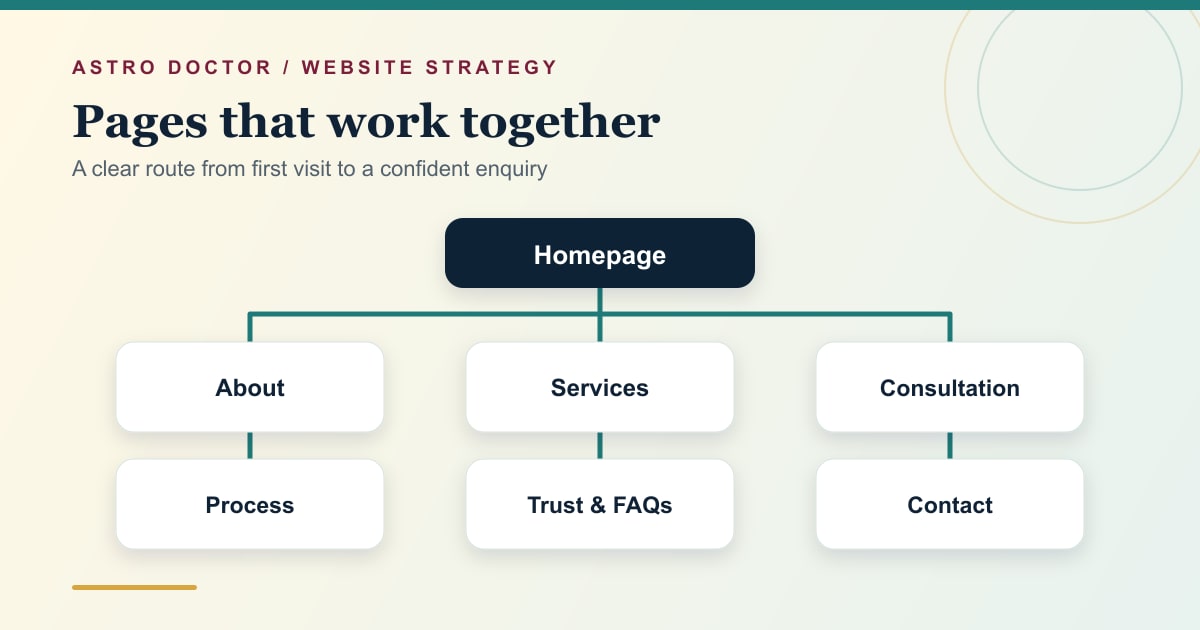
The right structure depends on what the practitioner actually offers, how clients consult, where the business operates and what a prospective client needs to understand before making contact.
A solo astrologer serving local appointments may need a compact website.
An established online consultant serving clients across countries may need separate service pages, a consultation process, stronger profile content and more substantial educational resources.
An astrology institute may need a completely different architecture involving courses, faculty, admissions and events.
The objective is therefore not to copy a standard 20-page website checklist.
The objective is to create a structure in which every important visitor can answer:
Who is this professional? What do they offer? Is the service suitable for me? How does consultation work? Can I trust the information? What should I do next?
This guide explains the pages that usually deserve consideration and how to decide which ones belong on a particular astrology website.
1. Begin with the business model, not the menu
Before creating the sitemap, define how the practice operates.
Questions include:
- Is the site built around one astrologer or a team?
- Are consultations local, online or both?
- Is the practitioner known primarily for one speciality or several?
- Are courses or training sold?
- Are there physical branches?
- Is there a premium/private advisory service?
- Are consultations booked directly or after an enquiry?
- Are fees displayed publicly?
- Does the business serve one country or an international audience?
The answers determine which pages users need.
A website should reflect the real operating model.
2. Homepage
The homepage should introduce the practice without attempting to explain every service in full.
A strong homepage usually answers:
- who the practitioner/business is;
- primary positioning;
- main services;
- local or online availability;
- why a prospective client may consider the practice;
- how consultation works at a high level;
- trust signals;
- next step.
The homepage should not become every service page
A common mistake is to place:
- career astrology;
- marriage astrology;
- business astrology;
- Vastu;
- numerology;
- tarot;
- gemstone;
- courses;
- daily horoscope;
- testimonials;
- contact;
- every city;
into one extremely long page.
This creates breadth but often weakens clarity.
Use the homepage to route people to the right deeper page.
3. About the Astrologer / About the Practice
For a trust-sensitive advisory service, the About page is not decorative.
A prospective client may want to understand:
- real professional identity;
- background;
- years of experience where verifiable;
- education/training where relevant;
- approach;
- languages;
- consultation mode;
- professional philosophy;
- genuine speaking/media references;
- boundaries.
Avoid vague claims such as:
"world-famous astrologer"
without defensible evidence.
The About page should make the person or organisation easier to evaluate.
4. Main Consultation / Services Overview
A services overview can help visitors understand the complete offer before opening individual pages.
Possible categories:
- Vedic astrology consultation;
- career consultation;
- business consultation;
- relationship/marriage consultation;
- online consultation;
- numerology;
- Vastu;
- education/courses.
Only list genuine services.
This page can act as a directory.
It should not duplicate the entire copy from each individual service page.
5. Important Individual Service Pages
An important, distinct service may deserve its own page.
For example:
- Career Astrology Consultation
- Business Astrology Consultation
- Online Astrology Consultation
A dedicated page is justified when the visitor has a distinct need that cannot be answered well inside a generic services page.
A strong service page may explain:
- who it is for;
- typical questions covered;
- what the consultation includes;
- preparation;
- format;
- duration where appropriate;
- online/in-person availability;
- process;
- pricing if intentionally public;
- limitations;
- FAQs;
- next step.
Do not automatically create one URL for every phrase in a keyword tool.
For the full decision framework, see Should an Astrologer Create a Separate Website Page for Every Service?
6. Online Consultation Page
If remote consultation is commercially important, a dedicated online page can answer operational questions such as:
- video/phone platform;
- countries/time zones;
- payment;
- birth information required;
- language;
- booking;
- rescheduling;
- preparation;
- follow-up.
This page targets online-service intent rather than local-office intent.
It can be particularly important for NRI and international audiences.
7. Consultation Process / How It Works
Many websites explain the subject but not the process.
A process page can reduce uncertainty.
Example sequence:
- Select or enquire about a service.
- Share required basic information.
- Confirm appointment.
- Make payment where applicable.
- Receive meeting details.
- Attend consultation.
- Follow the stated follow-up policy.
The exact workflow depends on the practice.
A process page is especially useful for premium or online consultation businesses.
8. Fees / Packages
Not every practice must publish prices publicly.
But the website should decide intentionally.
Possible approaches:
Full pricing
Useful when services are standardised.
Starting fees
Useful when scope varies.
Request details
Useful when the work is genuinely customised.
Avoid hiding basic information simply to force a WhatsApp conversation if the resulting enquiries are consistently poor quality.
Pricing clarity can be part of qualification.
9. Booking / Contact Page
A contact page should do more than show a phone number.
Useful information may include:
- WhatsApp;
- phone;
- email;
- appointment method;
- office location where genuine;
- office hours;
- online availability;
- enquiry form;
- expected response time.
Do not expose personal details unnecessarily.
If WhatsApp is central, connect the page to a structured enquiry process rather than opening an empty chat.
See WhatsApp Marketing for Astrologers for the enquiry-flow strategy.
10. Location Page — Only When Real
A local practice may need:
- one office page;
- branch pages;
- service-area information.
A location page can contain:
- genuine address;
- map;
- directions;
- nearby landmark;
- appointment requirements;
- local services;
- office photographs;
- opening hours.
Do not create a local page for every city simply because users search the city name.
The location must create real user value.
11. Google Business Profile / Local Visibility Support Page
This does not mean the practitioner needs a public page called "Google Business Profile."
Rather, the website should contain enough location/business information to support the real local entity.
For an eligible business, website location information and Google Business Profile should agree.
Local visibility depends on accurate real-world representation.
12. Frequently Asked Questions
A dedicated FAQ page can be useful when many questions do not belong naturally on individual services.
Examples:
- What details are needed?
- Is consultation online?
- Is appointment required?
- Can a family member attend?
- How is rescheduling handled?
- Which languages are available?
- How long is the session?
- What payment methods are accepted?
However, the most relevant FAQs should still appear on the corresponding service page.
Do not create hundreds of one-line FAQ pages.
13. Testimonials / Reviews
There are several options.
Testimonials integrated into relevant pages
Often best for context.
Dedicated testimonials page
Useful when there is enough genuine material.
External review links
Useful where trust is already established on independent platforms.
Always use genuine permission-safe feedback.
Do not fabricate reviews.
Avoid publishing sensitive client details.
14. Case Studies / Examples
Astrology is a sensitive advisory category.
Case studies should therefore be approached carefully.
Possible forms:
- business/marketing case study for an astrology brand;
- educational process example;
- anonymised client journey where explicit permission and ethical handling exist.
Avoid sensational "prediction proved correct" claims used as marketing evidence.
If no genuine case material exists, do not create a placeholder pretending to be proof.
15. Insights / Articles
A professional website can benefit from a knowledge section when it answers genuine audience questions.
For an astrologer's own website, topics should relate to the practitioner's real expertise and the questions their clients research.
For Astro Doctor, the Insights section remains focused on:
- marketing;
- websites;
- SEO;
- advertising;
- lead generation;
- branding.
The content focus should match the site's primary purpose.
16. Privacy Policy
A professional website collecting:
- names;
- phone numbers;
- emails;
- birth information;
- messages;
- payment or booking details;
needs clear privacy handling appropriate to applicable law and actual data practices.
The privacy page should reflect what the site really collects.
Do not copy a generic policy that refers to technologies/services the site does not use.
17. Terms / Consultation Policy
Useful topics may include:
- booking;
- payment;
- cancellation;
- rescheduling;
- refund policy;
- scope;
- limitations;
- consultation recordings where relevant;
- prohibited misuse;
- jurisdiction where appropriate.
Legal wording should be reviewed according to the business and applicable law.
18. Disclaimer / Professional Boundaries
An astrology practice should communicate boundaries responsibly.
The exact disclaimer depends on:
- country;
- service;
- claims;
- professional model.
Do not rely on a disclaimer to justify misleading claims.
Responsible marketing begins with the claims themselves.
19. Courses / Education Pages
If the practitioner teaches astrology, separate education intent from consultation intent.
Useful architecture may include:
- Courses
- Individual Course
- Curriculum
- Faculty
- Admission
- Schedule
- FAQs
- Student support
Do not force course queries onto consultation pages.
20. Media / Speaking / Publications
Where genuine material exists, an authority page can include:
- interviews;
- lectures;
- conference participation;
- published articles;
- books;
- podcasts.
Only include verifiable references.
This can strengthen the professional entity for users.
21. Which pages belong in the primary navigation?
Not every page deserves a top-level menu item.
A simple navigation may contain:
- Home
- About
- Services
- Consultation
- Insights
- Contact
Submenus can contain service categories.
A menu with 30 equally weighted links creates decision fatigue.
Architecture and navigation are related but not identical.
22. Which pages should appear in the footer?
The footer is useful for:
- important services;
- About;
- Contact;
- Privacy;
- Terms;
- key resources;
- location/business information.
Do not use the footer as a keyword block.
23. A sample structure for a solo professional astrologer
Main
- Home
- About
- Services
- Online Consultation
- Consultation Process
- Insights
- Contact
Services
- Career Astrology
- Business Astrology
- Relationship/Marriage Astrology
Trust / utility
- FAQs
- Reviews
- Privacy
- Terms
This may be enough.
24. A sample structure for a larger astrology institute
Main
- Home
- About
- Consultations
- Courses
- Faculty
- Insights
- Events
- Contact
Consultation cluster
- Online Consultation
- Career
- Business
- Relationship
Education cluster
- Course overview
- individual programme pages
- admissions
- faculty
- schedule
The website grows because the business model requires it—not because SEO demands a page count.
25. A useful page test
Before creating a page, answer:
- Does the visitor have a distinct question?
- Is this content substantially different from existing pages?
- Does the business genuinely offer it?
- Can we explain it in useful depth?
- Is there a logical next step?
- Can the page be maintained?
- Does it fit the site's primary purpose?
If several answers are no, reconsider the page.
26. Build architecture before visual design
Website projects often begin with:
- colours;
- hero banners;
- logo size;
- photographs.
Those matter, but they should follow architecture.
First decide:
- user groups;
- services;
- intent;
- page structure;
- internal links;
- conversion routes.
Then design the interface around the information.
That is the foundation of website design for astrologers that supports both SEO and lead quality.
Final perspective
A professional astrology website should contain enough pages to explain the practice properly—but no more than it can justify.
The strongest architecture is neither a one-page brochure nor a 500-page keyword network.
It is a clear system in which every page has a reason to exist.
Frequently Asked Questions
How many pages should an astrologer website have?
There is no universal number. A focused solo practice may need fewer than 15 strong pages, while an institute or multi-service business may require substantially more. Build around genuine user needs and business structure.
Is a one-page website good for an astrologer?
It can work for a very simple early-stage presence, but it limits depth when several distinct services, search intents, locations or educational resources need explanation.
Should every astrology service have its own page?
No. Separate services only when the intent and content are meaningfully distinct. See the next guide in this batch for the full decision framework.
Should an astrologer publish prices?
It depends on service structure and positioning. Pricing can improve qualification, but customised engagements may need a different approach.
Does an astrology website need a blog?
It needs useful content, not a blog for its own sake. Publish articles when they answer real client questions and support the site's expertise.