
That does not automatically mean the website needs ten separate SEO pages.
At the same time, placing every important consultation on one generic "Services" page can prevent both users and search engines from understanding the depth and differences between them.
The correct approach lies between these extremes.
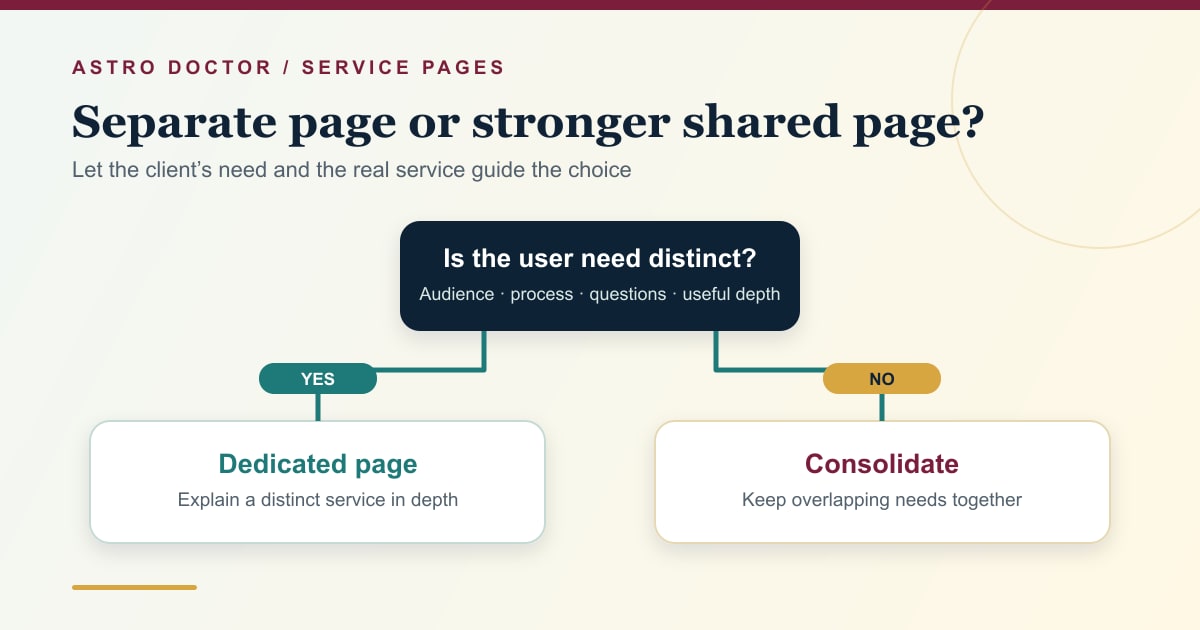
A separate service page should exist when it gives a specific audience a substantially better answer.
This guide provides a decision method.
1. Start with service reality
List what the practitioner genuinely provides.
For example:
- Vedic astrology consultation;
- career consultation;
- business consultation;
- relationship consultation;
- marriage matching;
- online consultation;
- numerology;
- Vastu.
Do not start with keywords.
Start with services.
Then identify which services:
- generate meaningful enquiries;
- require different preparation;
- have different process;
- have different audiences;
- deserve deeper explanation.
2. Search intent is the main reason to separate pages
Compare:
career astrology consultation
and:
business astrology consultation
A person searching either term may have a different problem, expectations and decision process.
Separate pages can be justified because the intent is meaningfully different.
Now compare:
online astrologer consultation
and:
virtual astrology consultation
These may represent the same underlying intent.
Creating two almost identical pages is unnecessary.
Group close variants into one strong topic page.
3. A page should answer a distinct question
Before creating the URL, complete this sentence:
This page exists because someone searching for ______ needs information that is not adequately explained on ______.
If the answer is weak, the page may not deserve to exist.
4. Separate page: good case
A dedicated Business Astrology Consultation page could discuss:
- entrepreneur/business audience;
- types of business questions covered;
- consultation process;
- information required;
- scope/limitations;
- online format;
- fees;
- FAQs.
That is different enough from a relationship consultation page.
5. Separate page: weak case
Creating:
/best-business-astrologer//business-astrology-expert//business-astrologer-online//top-business-astrologer/
with substantially the same content is not useful architecture.
These are keyword variations, not necessarily separate user needs.
One strong business-consultation page can naturally address several related terms.
6. Use topic families
A topic family groups close searches under one useful page.
Example:
Page
Online Astrology Consultation
Natural variations
- online astrologer consultation
- virtual astrology consultation
- astrologer consultation online
- remote astrology consultation
- video astrology consultation
Do not create five pages.
One page should cover the topic completely.
7. When to consolidate similar services
Two services may be combined if:
- audience is the same;
- process is the same;
- preparation is the same;
- search intent overlaps heavily;
- current pages repeat most content;
- one page has little independent value.
Consolidation can produce a stronger page.
If existing pages have rankings or links, use appropriate redirects when merging.
Do not simply delete established URLs.
8. When to keep services separate
Keep pages separate when:
- search intent differs;
- process differs;
- target audience differs;
- service is commercially significant;
- enough unique content exists;
- visitors need different FAQs;
- internal links can support each page distinctly.
The distinction should be visible in the copy.
9. Avoid the 300-word service-page trap
A common SEO workflow produces one page per keyword and gives each page:
- one paragraph;
- four benefits;
- three FAQs;
- CTA.
The result is a site with many pages but very little substance.
A service page should reduce uncertainty.
It can explain:
- fit;
- process;
- preparation;
- delivery;
- limits;
- price;
- alternatives;
- next step.
Word count is not the objective.
Decision usefulness is.
10. Do not create separate pages merely for singular/plural variations
Examples:
- astrologer service
- astrologer services
- astrology consultation
- astrology consultations
Do not map grammar variations to separate URLs.
Modern search systems understand language variation.
Write naturally.
11. Service plus city combinations need even more caution
Suppose there are 6 services and 20 cities.
A matrix creates 120 URLs.
This is easy to generate and difficult to justify.
Ask whether:
- the business genuinely serves that city;
- the service is locally distinct;
- the page contains unique local information;
- a user benefits.
If not, do not create it.
Read Astro Doctor's city-page guide for the local SEO dimension.
12. Think about cannibalisation before publishing
Cannibalisation is not simply "two pages use the same word."
The real concern is when multiple pages target substantially the same intent without a clear role.
Example:
Page A
Online Astrology Consultation
Page B
Best Online Astrologer
Page C
Online Vedic Astrologer Consultation
If all three are essentially the same commercial page, Google and users may receive conflicting signals.
Before publishing a new URL:
- search the site;
- inspect current pages;
- decide what query/intent each owns.
13. Use the title, H1 and introduction to establish purpose
A page's role should be clear immediately.
Example:
Title
Business Astrology Consultation | Online Advisory
H1
Business Astrology Consultation for Entrepreneurs and Business Owners
The page can then address related terminology naturally.
Avoid turning the title into a long list of every keyword variant.
14. Build a parent-child service structure
A useful architecture can be:
Parent
Astrology Consultations
Children
- Career Astrology
- Business Astrology
- Relationship Astrology
- Online Consultation
The parent summarises and routes.
Children go deeper.
This gives both people and search engines a clear hierarchy.
15. Internal linking should explain the relationship
Use contextual links.
Example:
If the primary concern is professional growth rather than business ownership, review the Career Astrology Consultation page.
The anchor is descriptive.
Avoid dozens of identical exact-match footer links purely for SEO.
16. Do not repeat the same FAQ everywhere
FAQs should reflect the service.
Weak:
- What is astrology?
- Why choose us?
- Is astrology accurate?
on every page.
Better:
- What information is required for business consultation?
- Can the consultation include more than one business?
- Is this available online?
- What is the follow-up policy?
Distinct FAQs reinforce distinct page purpose.
17. Use unique proof where available
A service page may include:
- relevant professional experience;
- service-specific review;
- process;
- genuine example;
- relevant media/speaking reference.
Do not copy the same proof block to every page if it has no relationship to the service.
18. Consider the visitor's stage
Some pages are:
Early research
Educational article.
Comparison
Service overview.
Decision
Specific consultation page.
Action
Booking/contact.
The architecture should support movement between stages.
Not every search needs a commercial page.
19. Use Search Console to test architecture over time
After pages are indexed, review:
- which page Google shows for a query;
- whether multiple pages appear for the same intent;
- impressions;
- clicks;
- CTR;
- unexpected queries.
If the wrong page repeatedly ranks, review:
- internal links;
- title/H1;
- content role;
- overlap.
Do not constantly change pages based on a few impressions.
20. What if several existing pages are already similar?
Audit them.
For each page record:
- URL;
- target intent;
- title;
- H1;
- traffic;
- impressions;
- backlinks;
- internal links;
- content uniqueness.
Then decide:
Keep
Distinct intent.
Merge
Substantially same intent.
Reposition
Page has potential but role unclear.
Redirect
Obsolete duplicate.
Do not mass-delete.
21. What about numerology, Vastu or tarot pages on an astrology site?
Create them only if they are real parts of the professional offer.
If the practitioner has meaningful expertise and clients for them, separate pages may make sense.
If they are added only because competitors list them, they can dilute positioning.
The website should reflect professional reality.
22. A six-question service-page test
Create a separate service URL when most answers are yes:
- Is the service genuinely offered?
- Does it have distinct search/user intent?
- Can we write substantially unique information?
- Does it matter commercially?
- Does the visitor need different process/FAQ information?
- Can the page be linked naturally from the site's architecture?
If several answers are no, consolidate.
23. Example architecture
Better
/consultations/
- Career
- Business
- Relationship
- Online
Each child explains a distinct need.
Weaker
/best-astrologer/ /top-astrologer/ /famous-astrologer/ /expert-astrologer/
with near-identical content.
The first is a service architecture.
The second is a keyword architecture.
24. Service pages and articles should not replace each other
A service page answers:
Do you provide this and how does it work?
An article answers:
What should I understand about this topic or decision?
Example:
Service
Career Astrology Consultation
Article
What Should You Prepare Before a Career Astrology Consultation?
Link them.
Do not make both pages contain the same copy.
25. Keep the site manageable
Every new URL creates:
- maintenance;
- internal-link responsibility;
- metadata;
- content updates;
- analytics;
- potential duplication.
Publishing a page is easy.
Maintaining a coherent website is harder.
That is why fewer stronger pages often outperform uncontrolled expansion.
Final perspective
An astrologer should not create a separate page for every service name or keyword variation.
Create a separate page when the user need is separate.
That one principle improves:
- content quality;
- SEO clarity;
- internal linking;
- conversion;
- maintenance.
FAQs
Should career and business astrology have different pages?
They can if the audiences, questions and consultation context are distinct enough to justify separate useful content.
Should "online astrologer" and "online astrology consultation" be separate pages?
Usually not if they represent the same service intent.
How long should an astrology service page be?
As long as needed to answer the decision properly. There is no useful universal word-count rule.
Can too many similar pages hurt SEO?
Large groups of overlapping, thin or repetitive pages can weaken quality and make page selection unclear. Consolidate when the intent is substantially the same.
Should city and service pages be combined?
Only when the local/service combination represents genuine local value. Avoid programmatic city-service matrices.